Tuesday, 30 July 2019

Crofting and the repairing standard


Seven keystrokes (" to (e)") in a recent statutory instrument consulted upon under the headline of Energy Efficiency will radically alter the law in relation to some crofts in 2027. The change could cause major financial headaches for community landowners such as Storas Uibhist and Stornoway Trust. It could also lead to significant rent increases for the affected crofters (a minority) but with the potential upside for them of 6-figure windfall gains.

Croft house at Kilchoan - picture credit A Kilchoan Diary
    
There have for a long time been obligations upon landlords of private sector residential tenancies to maintain let houses to certain standards. The most recent iteration of these is Chapter 4 of the Housing (Scotland) Act 2006. Section 14(1) of this requires the landlord to ensure that a house meets the “repairing standard” set out in section 13. This includes (amongst other things) that the house is “wind and water tight and in all other respects reasonably fit for human habitation”. Since 1 March 2019, it also requires that the house meets “the tolerable standard”. That is defined in section 86 of the Housing (Scotland) Act 1987 and includes that the house is “substantially free from rising or penetrating damp”. And from 1 March 2024, the repairing standard includes that houses must have “fixed” (i.e. central) heating systems. [1]
 
The repairing standard (and previous iterations of residential landlords’ maintenance responsibilities) has never applied to farm tenancies – farm houses and cottages on let farms. That’s because farm tenancies have always had their own distinct statutory maintenance regime. Without going in to the detail of that, it’s fair to say it’s less rigorous on landlords of farms than the repairing standard (RS). But in 2018 the Scottish Government decided the RS should be applied to houses on farm tenancies as well. In legislative terms, this was effected by regulation 2(2) of The Housing (Scotland) Act 2006 (Modification of the Repairing Standard) Regulations 2019 repealing s.12(1)(c) of the 2006 Act (the paragraph which had excluded farm tenancies from the repairing standard). However, this doesn’t take effect until 2027 in order to give farm landlords a reasonable lead in time to their more exacting responsibilities.

Farmhouse at Gairloch

Before I continue, the inevitable terminological point: I use the expression “farm tenancy” to refer to a tenancy of an “ordinary” farm which is not subject to the crofting legislation. For any agricultural lawyers reading, a farm tenancy could be a 1991 Act Tenancy or a Limited Duration Tenancy or any of the other more recent types. Though not a legal term of art, I’ve made up “farm tenancy” to distinguish them from “crofting tenancies” which are self explanatory. By “agricultural tenancies”, I mean farm and crofting tenancies.  

Houses on crofting tenancies have never been subject to any obligation upon the landlord to maintain them. That’s because the historical facts of crofting are that, unlike with farm (and urban residential) tenancies, it was almost invariably the tenant who built the house on his croft. Thus, it was his to maintain. Croft houses do not in any meaningful sense “belong” to the landlord like other rented houses, urban or rural, do. For any lawyers old enough to appreciate the analogy, the relationship of a crofting landlord to a croft house is, in practical (if not strictly legal) terms, much closer to that of feudal superior of the house than landlord. Thus, crofting tenancies were also excluded from the repairing standard by s.12(1)(d) of the 2006 Act.

But the recent extension of the repairing standard has also brought houses on crofting tenancies under its ambit from 2027. (2019 regulation 2(2) also repeals s.12(1)(d).) Thus, crofting landlords could for the first time be faced with claims from crofters to upgrade houses for which only a pittance of rent is paid (£10-20 a year is typical for a croft – c.f. feuduties).

There are about 15,000 crofting tenancies in Scotland but only a smallish minority have houses on them. That’s because, since 1976, crofting tenants have had the right to take a freehold title to their croft houses for a nominal sum (£25-50 is typical) [2]. Most crofters have exercised this right in order to be able to mortgage the house to fund improvements to it. But there are probably as many as four figures of croft houses still in tenancy. Moreover, these are likely to be the ones most in need of being brought up to the repairing standard. A typical scenario would be the croft where the last active resident tenant died 20-30 years ago, not having exercised his right to buy due to never having seen the need during his life to improve his 75 year old house. The tenancy is now held by family members who live elsewhere, rent the land informally to neighbours and visit the house only for occasional holidays with the consequence that it’s deteriorated for want of being lived in and regularly maintained. A crofting estate could have several, if not dozens, of houses in that situation and, in 2027, the crofters could ask their landlords to do them up for them by invoking the repairing standard. Then, after the landlord has spent a five figure sum doing that, the crofter could invoke the right to buy at the nominal £25-50 and sell the newly renovated house on for six figures!

Few are likely to shed tears over the travails of crofting landlords until it’s remembered that a substantial number of crofts – possibly around a third of them – are on estates belonging to community bodies (Stornoway Trust, North Harris, South Uist, North Assynt et al). So let’s pick this apart in more detail and see if the repairing standard really is as much of a threat to the fragile finances of these third sector landlords as it appears on the surface. (Note that, from hereon, when I refer to croft houses, I’m referring only to those – a minority – which are still in tenancy, not those which have been bought and will remain wholly the responsibility of their owners. And by “crofter” I mean only those whose houses are still in tenancy.)

Crofts on South Uist belonging to community landlord Storas Uibhist - picture credit Allan Macdonald

First, the repairing standard doesn’t require landlords to carry out work “for which the tenant is liable by virtue of the tenant's duty to use the house in a proper manner” (2006 Act, s.16(1)(b)). So the argument would be that, by allowing a croft house to have deteriorated, the tenant has not “used it in a proper manner” and therefore the landlord is not liable to carry out work to bring it back up to the repairing standard. But are crofters under a duty to “use their houses in a proper manner” prior to 2027 when the 2006 Act will start to apply to them? Amongst the statutory conditions of crofting tenancies is that the tenant “shall not, to the prejudice of the interest of the landlord ... injure the croft ... by allowing the dilapidation of buildings” (Cond. 5). But is that the same thing as “using buildings (including houses) in a proper manner”? There has been no attempt to synchronise the Housing Act with the Crofting Act consequent upon the repairing standard being applied to crofting tenancies so as to remove such doubts and questions. Consequently, I would be hesitant about advising a crofting landlord that s.16(1)(b) of the 2006 Act (benefit of repairing standard conditional upon tenant having used the house in a proper manner) could be relied upon as a defence to a claim by a crofter to do substantial work to upgrade his house in virtue of the repairing standard. But on the other hand, I would warn a tenant that s.16(1)(b) could represent a significant obstacle to his claim. I suspect that, if the matter came to be tested in court, the answer might depend on how sympathetic the court was to the whole policy of applying the repairing standard to crofting tenancies and whether the court wanted to support it or neuter it.

Be that as it may, it’s possible to imagine a slightly different scenario in which a crofting tenant has scrupulously maintained his house such that there’s no question of him having not “used it in a proper manner” (Housing Act) or “allowed its dilapidation” (Crofting Act). But it’s an old house which no amount of continued maintenance, however meticulous, is going to bring near the modern repairing standard (think old wooden sash and case windows). Indeed, the house may not have reached the repairing standard even when it was brand new in the 1930s. In this scenario, the landlord doesn’t even have the possibility of a defence under s.16(1)(b) to a claim by the tenant to bring it up to the repairing standard. And aside from these more dramatic scenarios of total refurbishment of an old sub-standard house, there are the more everyday cases of something needing fixed like the central heating boiler or just a broken window or loose slate: up until now that has been the crofter’s responsibility but from 2027 it will be the landlord’s to do free of charge to the crofter!

There’s another very commonly occurring crofting scenario worth looking at here. On many crofts, the crofters have built a new house on a different site from the old house which was left standing. They take title to the new house and the old one is left in tenancy. Could the crofter invoke the repairing standard (RS) to require the landlord to do up the old house? I think that’s much more doubtful. The reason is that the RS only applies to the tenancy of “a house let for human habitation” (2006 Act, s.12(1)). Now, considering that there is also amongst the statutory conditions of crofting tenancies a prohibition on there being more than one inhabited house on a croft at a time (Cond. 8), the old house is surely no longer “let for human habitation”. There are counter arguments to that, though. If title is taken to the new house, then the tenanted remainder of the croft is back in the situation of having only one house on it, the old one. Perhaps even more compelling is the argument that a landlord is entitled to waive compliance with the statutory condition and allow two inhabited houses on a croft. I personally know of one where the old house was lived in by adult unmarried children of the crofter who lived in the new house. This sort of scenario will not be unique.

An example
Below is an advert I found for the sale (assignation) of a crofting tenancy where the house is still in tenancy: click it to enlarge. I've anonymised it. It's one of those crofts where there's an old house and a new house but note that even the "new" house, built in the 1950s, is "requiring complete renovation". It's a fair guess that house comes nowhere near the repairing standard. So should the purchaser (assignee) resist the suggestion in the brochure to purchase (take a freehold title to) it and instead leave the house in tenancy and wait until 2027 and get the landlord to carry out the required renovation at his expense?


Let’s move on and imagine a crofter has been successful in invoking the repairing standard and compelled the landlord to do substantial work to improve his house. It may not be a total “freebie” for the crofter because the landlord could increase the rent to compensate him (the landlord) for his expenditure. The rent for a croft can, on the application of the landlord or the tenant to the Land Court, be revised (up or down) to whatever is the “fair rent” [3]. This is not the place to go into the case law about what a “fair rent” for a croft actually means because croft rents are seldom reviewed in practice because they are usually so low that it’s not worth either party’s while tinkering with them. But the application of the repairing standard to croft houses puts a new complexion on this from 2027. It must surely be “fair” that a croft rent be considerably increased to reflect money a landlord has spent on a croft house. Indeed, it may also be “fair” to increase a croft rent to reflect the fact that the landlord could, for the first time, be called upon to spend money on a croft house (whether a complete refurbishment or just fixing the broken boiler or loose slate) even though he hasn’t done it yet. So an unintended consequence of applying the repairing standard to crofting tenancies could be that crofters could face a significant increase in rent for something they didn’t ask for.

Photos from another advert for an assignation of a croft tenancy where the house is still in tenancy. This time, the house looks as if it does meet the repairing standard but from 2027 keeping it that way will become the landlord's responsibility - will that result in an increase in the rent (currently £114pa)?

Could these crofters avoid the rent increase by electing to buy the freehold of their houses for a nominal price? As with croft rents, the statutory provisions relating to the calculation of that price are seldom paid much attention because the figures are so low. Time to look again now with renewed interest. Imagine the scenario where the crofter has sucessfully managed to get his landlord to spend a five figure sum bringing his house up to the repairing standard. Section 15(2)(a) of the Crofters (Scotland) Act 1993 says that the price is the open market value with vacant possession and free of crofting restrictions but – crucially – assuming there were no buildings on the site and no potential for getting planning permission to build anything (whether a house or anything else) on the bare site. This is why the prices paid by crofters for the freehold of their houses are so negligible. It reflects the fact that the overwhelming majority of croft houses were built at the expense of the tenants so it’s not fair that the landlord should get anything for them apart from the value of the bare land they’re built on. But s.15(2) of the Crofters Act covers the rare situation of the landlord having built the house by adding that:-

and in addition [to the OMV of the bare site], in a case where the landlord has provided [i.e. paid for] fixed equipment on the site [the crofter shall pay] an amount equal to one half of the proportion attributable to that fixed equipment, as determined by the Land Court, of the value of the site ...             

“Fixed equipment” is a term of art of Scottish agricultural tenancy law meaning the infrastructure of a farm or croft aside from the actual land itself, typically fences, roads, drains, fanks etc. It’s defined for the purposes of both crofting and farm tenancies in s.85(1) of the Agricultural Holdings (Scotland) Act 1991. The definition specifically includes houses. So could it be argued that, by carrying out work which transforms a sub-standard croft house liable to be condemned by the Council into a desirable one up to modern standards, the landlord has, in effect, “provided” the house so as to be entitled to half its value and thereby perhaps recover some or even all of his outlay? It’s not an entirely ridiculous argument but pretty doubtful nevertheless, I think. The case is much stronger where the landlord has added something to the house (a central heating boiler, for example), as opposed to work on the existing fabric – in that case I’d be a bit more confident in saying the landlord could claim half of the uplift in value of the house attributable to the addition (which may not necessarily be the same as half of the cost, of course).

Finally on this, a landlord can’t force a crofter to buy his house – the crofter who’s had his house improved by his landlord could choose to sit it out and pay incrementally through an increased rent. But the opportunity to buy a newly refurbished house at half its value (at most, possibly less for the reasons canvassed) is one many crofters will find hard to pass! Note as well that the 50% clawback a crofter who has bought his land must pay his landlord if he sells on at a profit within 10 years doesn’t apply to croft houses, only croft land. [4]

How did we get here? - the legislative process
The idea of extending the application of the repairing standard appears first to have emerged in 2015 at Stage 1 of the bill which was to become the Land Reform (Scotland) Act 2016. This proposed a range of changes to farm tenancies and, during their evidence gathering at Stage 1, the Scottish Parliament’s lead committee on the bill, the Rural Affairs, Climate Change and Environment (RACCE) Committee, learnt of the poor state of repair of some houses on farm tenancies. They accordingly recommended in their Stage 1 Report (paras. 555-558, pp. 118-119) that the Scottish Government bring forward amendments at Stage 2 of the bill to address this. The SG’s response (para. 281, page 72) to that was that, while it acknowledged the issue and was sympathetic to it:

As tenant farming houses interface with a range of legislation and policy areas, amendments to this Bill would not be the appropriate means to address this issue, given the amount of preparatory work needed to deliver robust and sustainable solutions.
  
Then, at Stage 2, an opposition MSP, Claudia Beamish (Labour), attempted to force the issue by tabling her own amendment (No. 152 on page 29) to the bill to apply the repairing standard (RS) to farm – but not crofting – tenancies. In the end, however, she withdrew it in exchange for an undertaking from the Minister (Richard Lochead) to give the matter higher priority. In the course of his remarks to the Committee the Minister remarked that the Beamish amendment would discriminate against crofters and also said: “We need qualitative and quantitative research to enable the Scottish Government to assess the range of issues, including costs, that must be addressed”. And in a reference to the “interface” mentioned in the SG response to the Stage 1 Report quoted earlier he alluded to the question of “what legislation will have to be amended or created to deal with the issue”. [5]


Thereafter, progress towards applying the repairing standard to agricultural (farm and croft) tenancies was subsumed in work to broaden the scope of the RS (i.e. include new requirements for all affected properties, not just agricultural tenancies) and require all rented houses to be brought up to Energy Performance Certificate Standard D by 2025 [6]. In April 2017, the Scottish Government launched a consultation on all of these issues. It would be fair to say, though, that the issue of applying the RS to agricultural tenancies was somewhat buried in this, occupying just two paragraphs (Nos. 189 & 190) out of a total of 205. The treatment of farm tenancies was sketchy enough (nothing about the “interface” with other legislation and policy areas the SG had given as its justification for not legislating in the Land Reform Bill and opposing the Beamish amendment) and there was nothing about the specialities of crofting tenancies: although they were mentioned as included in the proposal, it was plain from the wording that no thought had been given to them as distinct from farm tenancies at all. [7]

I have not read all the responses to the consultation. I only looked at a few of those which were not anonymous and which I thought might be likely to comment on specifically on crofting. There were no responses from crofting landlords that I spotted and only one response that I looked at in this small and unscientific sample – that from Scottish Land and Estates, the landowners’ “trade union” – raised the crofting implications. [8] The analysis of the responses to the consultation noted that 45% of respondees were against applying the RS to agricultural tenancies, 40% for and 16% don’t know. It also recorded that the interface with agricultural tenancy legislation issue had been flagged up in many responses (“complex and unworkable”) but didn’t mention SLE’s specific warning about crofting.

The Consultation did, however, say (para 190) in relation to agricultural tenancies (farm and crofting): “Clearly there are a range of issues which need to be explored further prior to considering a minimum standard for condition. Ministers are, however, mindful of potential condition issues and are committed to undertake research.” That was footnoted with a reference back to the Official Report (transcript) of the discussion in the RACCE Committee of the Beamish amendment and the Minister’s warnings about the need for research and the “interface” with other legislation. The results of the research subsequently undertaken by Rural & Environmental Science and Analytical Services (RESAS) are here. It’s a survey of the physical condition of farm houses and cottages as revealed by a questionnaire sent to farm tenants but not crofting tenants. It was also sent to some landlords, though they are not identified, and returns from them reported on 930 “tenant farm houses”. I’d guess that did not include any croft houses.  

Thereafter, the Ministers for Rural Affairs (Fergus Ewing) and Housing (Kevin Stewart) announced their intention to legislate to apply the repairing standard to “rented agricultural housing” at an Agricultural Housing Summit on 1 October 2018. I haven’t been able to find any more detail about that except for this press release.

Housing Minister Kevin Stewart at the Scottish Parliament

The statutory instrument to amend the Housing (Scotland) Act 2006 [9] to add additional requirements to the repairing standard (RS) for all residential tenancies and apply it, as so extended, to agricultural tenancies from 2027 was subject to the so-called “affirmative procedure”. This requires a draft of it to be approved by the Scottish Parliament before it’s made by Ministers so it came before the Local Government & Communities (LGC) Committee of the SP on 30 January 2019 for them to take evidence prior to making a report to the full Parliament recommending whether or not the draft instrument should be approved. [10] The LGC Committee contained nobody who’d been on the RACCE Committee which considered the Land Reform Bill in 2016 when the application of the RS to agricultural tenancies was first raised so it’s possible the LGC members had little, if any, prior acquaintance with the issue.  They were, however, provided with a “policy note” (scroll to Annexe B, page 15) but, apart from stating that farm and crofting tenancies were to be brought under the RS and linking to the Consultation and analysis of responses thereto, it contained no discussion. The Committee was attended by the Housing Minister, Kevin Stewart, and two of his civil servants but, again, apart from the Minister stating that the draft instrument brought the “various types of housing under agricultural tenancies” under the RS in implement of the commitment made at the Agricultural Housing Summit last year, and one MSP querying the length of the lead in time to 2027, there was no discussion in the Committee of the implications for crofting or farm tenancies: the discussion – which lasted only 17 minutes – focussed instead on the additions to the RS and its application to holiday lets. The Committee agreed unanimously to recommend approval of the draft instrument and reported in these terms to the full Parliament which approved it on 6 February 2019. The instrument was made and signed by Kevin Stewart on 20 February and it came into force on 1 March 2019.

It’s very hard to avoid the conclusion that crofting tenancies were just tacked on to farm tenancies on the assumption they were the same thing and that not a moment’s thought about whether it was correct or appropriate to apply the repairing standard to them was ever given by anyone in authority – except possibly Claudia Beamish MSP (who’s amendment to the Land Reform Bill didn’t include crofts) and RESAS (who’s questionnaire was not sent to crofters). In particular, there doesn’t appear to have been any of the “qualitative and quantitative research” or consideration of the “interface with a range of legislation and policy areas” as regards the implications for crofting which the Scottish Government said would be necessary before extending the application of the repairing standard. [11]  

I shouldn’t be in the slightest bit surprised if the SG doesn’t even realise that, as one of Scotland’s biggest crofting landlords (Barra and large chunks of Skye), it has exposed itself to the potential for considerable liabilities. [12]

Crofts on Barra - picture credit Ian Watson
 
Footnotes
[1] That’s what the Housing Minister, Kevin Stewart, told the Scottish Parliament’s Local Government & Communities Committee on 30 January 2019 when explaining regulations he was introducing to amend the repairing standard: “The changes will require private rented housing to have ... a fixed heating system, which means that there will have to be a system or installation in houses for heating space and water.” (Official Report (transcript) of the meeting here, see Col. 27, 3rd para.) However, what s.13(1)(c) of the Housing (Scotland) Act 2006 as so amended now says (although note that the version linked to there doesn't have the reference to fixed heating because it's not in force yet) is: “the installations in the house for the supply of ... space heating by a fixed heating system and heating water are in a reasonable state of repair and in proper working order”. That doesn’t say there has to be a fixed heating system, merely that if one exists, it has to be in good condition. The same amending regulations added a new sub-section (7) to s.13 saying “In determining whether a house meets the standards of repair mentioned in subsection (1)(c) [heating system to be in good condition] ... regard is to be had to any guidance issued by the Scottish Ministers in relation to— ... installation of a fixed heating system.” As far as I can discover, no such guidance has yet been issued. Perhaps the Ministers intend to include in it a requirement to have a fixed heating system. But I’m not at all sure a positive obligation like that can be introduced by mere “guidance” one is only required to “have regard to”.
[3] Crofters (Scotland) Act 1993, s.6(3).
[4] Crofters (Scotland) Act, s.14(3) referring to the definition of “croft land” in s.12(3) which excludes the house.
[5] Official Report (transcript) of the Stage 2 RACCE Committee meeting here – see columns 45 (from “After section 97”) to 51
[6] In a parallel move to amending the repairing standard (RS) and applying it, as so amended, to agricultural tenancies, the Scottish Government intends to require all houses which are subject to the RS also to be brought up to at least Energy Performance Certificate Standard D ("EPC D") by 2025. Being EPC D won't be part of the RS, it's a separate standalone requirement which applies to houses which are subject to the RS and which will be enforced by local authorities with the sanction of civil penalties (as opposed to being enforced by the tenant as a matter of contract as a condition of his tenancy as is the case with the RS itself). 

Whether landlords of croft houses will be subject to the EPC D requirement from 2027 will depend on the devil in the detail of regulations to introduce it (being made under Chapter 3 of the Energy Act 2011, a UK Act) which haven't been published yet. For now, all I have to go on for the detail of the scheme is this guidance. The reason for hesitancy is that, as well as being subject to the RS, there is an another pre-condition for the EPC D requirement which is that the house has an Energy Performance Certificate (EPC) - see paras. 2.1.1 and 2.2.1 of the linked guidance. Aside from specialities such as participation Green Deals and Feed In Tariffs, a house generally only has to have an EPC if it has been sold or had a new tenancy of it granted since 2009 - see para. 2.6.1. Tenanted croft houses are never sold - if they change hands, what happens is that the tenancy is assigned (transferred) to a new tenant who continues with the same tenancy which will date back to long before 2009. Due to crofting security of tenure and the ability to assign and bequeath them, tenancies of croft houses very seldom come to an end such that the landlord is in a position to grant a new tenancy to trigger the requirement for an EPC. (I shouldn't be in the least surprised to be told this has never happened since 2009.) Thus, very few tenanted croft houses require to have an EPC nor will they in the future. That said, when I searched for assignations of crofting tenancies with houses on them for sale, out of the four I found, two of them advertised EPC ratings (one D, the other F). I'm guessing the estate agents advised the sellers, for the sake of £100, to get an EPC to avoid any argument with an over zealous Council enforcement officer that the assignation of a tenancy of a croft house is a "sale" of it for the purposes of the EPC Regs if not strict property law.

It will, therefore, depend very much on the exact wording of the forthcoming regulations for the EPC D upgrade by 2025 and whether they say it applies to houses covered by the repairing standard which require to have an EPC (which will exclude the overwhelming majority of tenanted croft houses) or to houses which happen to have one even though not required. The wording of the linked guidance rather suggests the latter which would be an odd way to legislate because it, in effect, gives tenants the right to opt in by paying £100 to get an EPC. Why not just say it applies to all tenancies covered by the RS?  

[7] The internal evidence in paras. 189 & 190 of the Consultation that crofts were not being discussed is that they state that “the landlord is responsible for replacing worn fittings” (which is true of many farm tenancies but not crofts) and “There are over 6000 agricultural tenancies in Scotland” (that is the number of farm tenancies: it does not include crofts).
[8] The Scottish Land & Estates response is here but to see their remarks about crofting, you have to access their original full response (a Word doc) linked to at the bottom of that page – see 2nd para. on page 37.
[9] The 2006 Act was amended by The Housing (Scotland) Act 2014, s.24 to add a new s.20A to the 2006 Act to allow the scope and application of the repairing standard to be varied by statutory instrument.
[10] Official Report (transcript) of the LGC Committee meeting here – start at column 26. Video here (after a few seconds it should snap to the start of the relevant discussion at about 11.03). Also under discussion at the same time was another draft SI, The Housing (Scotland) Act 2006 (Supplemental Provision) Order 2019, which is not relevant to the present discussion.
[11] The same legislation as applied the repairing standard to crofts has also applied it to Small Landholders Holdings (SLHs). That's because Reg. 2(2) of The Housing (Scotland) Act 2006 (Modification of the Repairing Standard) Regulations 2019 has also repealed s.12(1)(e) of the 2006 Act which excepted SLHs from the RS. SLHs are similar to crofts in the rest of Scotland outside the Crofting Counties although there are thought to be only about 60-70 SLHs left in existence – more information about them here. I've not discussed the implications of applying the RS to SLHs in this paper. Many of the points made in relation to crofting may apply equally to SLHs although I haven't refreshed my memory of the law of SLHs in order to be more definite: one big difference between crofts and SLHs is that tenants of SLHs have no statutory right to buy their houses or holdings like crofters do. The conclusion that the Scotgov gave crofts no thought in the legislative process definitely applies equally to SLHs, though.  
[12] The Housing (Scotland) Act 2006 binds the Crown (s.193) which includes the Scottish Ministers (s.193(5)(c)). Another public sector crofting landlord which will be affected by the application of the repairing standard to crofts is Shetland Islands Council which is the landlord of about 250 crofts. More information here. I didn't spot SIC amongst the Consultation responses.
        

Tuesday, 1 January 2019

Stornoway Windfarm

There's been renewed debate recently about windfarms on Lewis except this time it's not about whether there should be large scale windfarms on the island but who should build and operate them - the landlord in partnership with a multi-national energy giant or local crofters in partnership with a community development trust?

It’s classic big guys v little guys, capitalism v localism stuff. I’m more interested in the legal issues than the political, though, and, especially with crofting law in the mix, it throws up enough legals to keep a roomful of lawyers employed full time. In this first post, I’m just going to write about the factual background and history and some basic underlying law. Anyone reading this who lives on Lewis will likely already know all the facts and much of the law, especially the crofting.

Note - I don't know how to do linked footnotes so footnotes are in bold square brackets like this - [1] - and you just have to scroll down to the bottom if interested. Sorry!

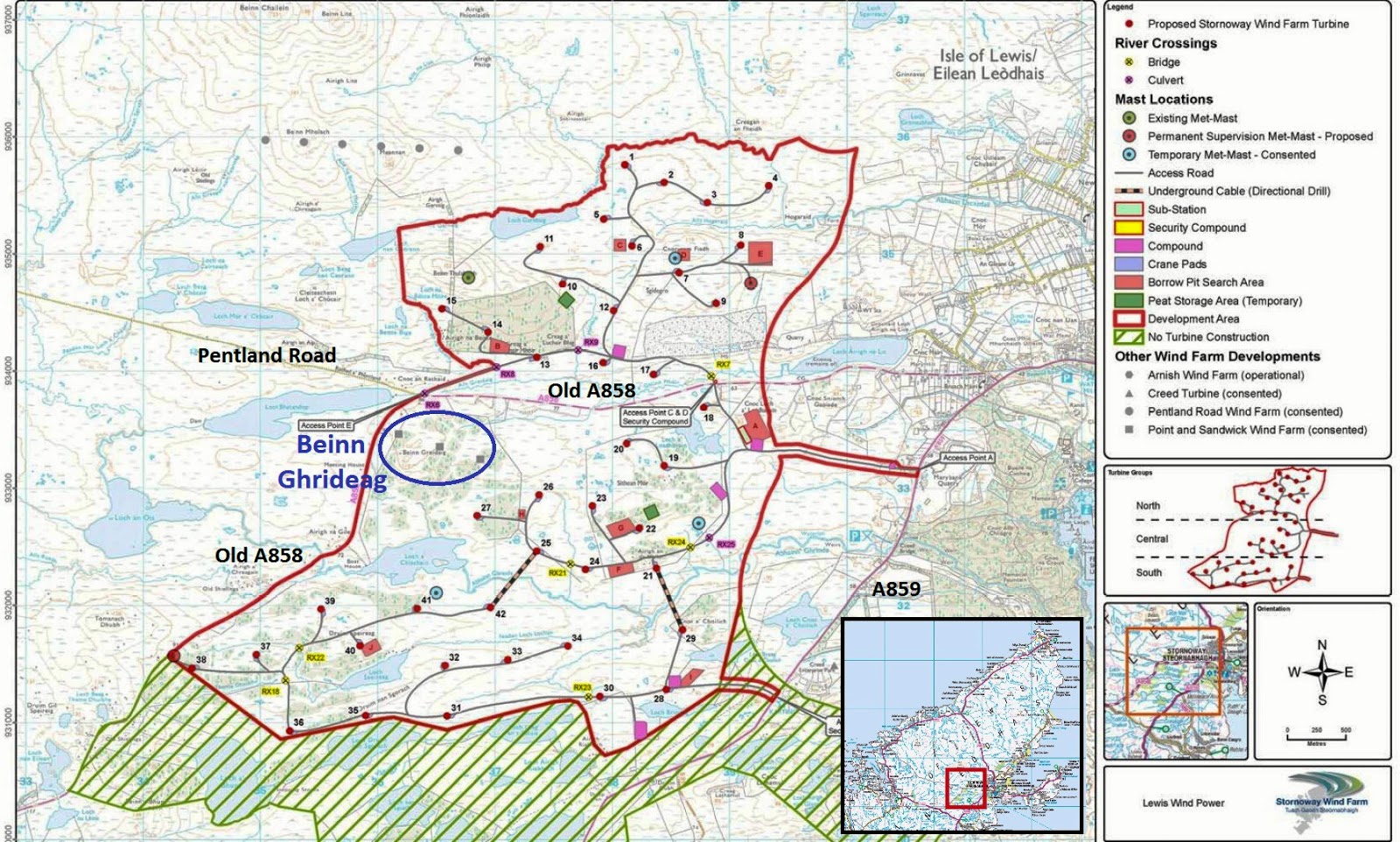
Click map to enlarge
History
Back in 2004, a company called Lewis Wind Power Ltd (LWP – see below for who’s behind it) entered into contracts with a number of landowners on Lewis to build what would have been the biggest windfarm in Britain. Involving 180 turbines (scaled back from an original 230 [1]) across a huge swathe of the northmost half of the island and attracting widespread local opposition, planning permission for this was eventually refused in April 2008, mostly on the grounds of adverse environmental impact (EU protected peatlands and nesting birds). But LWP didn’t give up their renewable energy ambitions on Lewis and moved to concentrate on a smaller scheme in a less environmentally sensitive area on land belonging to the Stornoway Trust about 3 miles west of Stornoway where there was also less local opposition. Long/short is LWP received planning permission [2] in September 2012 for 36 turbines 143.5 metres tall with an aggregate capacity of 129.6MW (Megawatts: I think that means that, if the turbines were all spinning at optimum speed, they could light up 1.3 million 100 watt bulbs). That permission was varied in 2016 to increase the size of the turbines to 145m giving tham an aggregate capacity of 180MW. [2A] But despite having had planning permission for a while, construction of the windfarm hasn’t started yet. This is for three main reasons which I’ll come to below but first who’s who.

LWP's Stornoway windfarm - click to enlarge
Who are LWP?
LWP started life as a joint venture between British Energy (BE), the privatised incarnation of the former state owned nuclear industry, and AMEC, an energy sector engineering company (not to be confused with Amey best known for building and maintaining roads). BE got into financial difficulties in 2009 and had to be bailed out by the Government who sold it to EdF (Electricité de France). This is the 85% French government owned electricity generator of France (where there has always been a much higher component of nuclear in the generation portfolio) turned multi-national. Thus, they own the Torness and Hunterston B nuclear power stations but also hold the contract for the supply of electrity to all Scottish public sector buildings (schools, hospitals etc.) so they’re no strangers here. [3] After being briefly known as AMEC Foster Wheeler, AMEC were taken over by Aberdeen based energy services firm The Wood Group in October 2017 which has since rebranded itself simply as “Wood”. So LWP is now a JV between EdF and Wood although it’s common to see just EdF referred to as the developer. (Paradoxically, it used to seem to be just AMEC that got mentioned.)

Strictly speaking, since 2016, the developer of the Stornoway windfarm has been a subsidiary of LWP called Stornoway Wind Farm Ltd. [4] This is to keep it legally separate from the 45 turbine/162MW windfarm project which LWP bought in 2016 called Muaitheabhal (“MOO-aya-val”) on privately owned Eishken Estate about 12 miles south of Stornoway. This is the one that was originally being progressed by Beinn Mhor Power Ltd, a company owned by the owners of Eishken, the Oppenheim family – it wasn't part of the original LWP scheme turned down in 2008. Also not built yet, and more recently being referred to as Uisenis (“OOSH-i-nish”) windfarm [6], it’s less controversial because it’s not on crofters’ common grazings. I'm going to continue to refer to LWP as that’s how they brand themselves at both projects despite the underlying corporate structure. And references hereafter to LWP’s windfarm are to the Stornoway one, not Muaitheabhal/Uisenis. [7]


The Stornoway Trust (SYT)
The owner of the land LWP’s Stornoway windfarm will be sited on is Scotland’s oldest community landlord. When the last private owner of the whole of Lewis, Lord Leverhulme (eponym of today’s Unilever), disposed of the island in lots in 1923/24, he gifted the entire parish of Stornoway [8] to its residents. The gift is administered by trustees periodically chosen by all residents on the Voters Roll in elections overseen by the Electoral Reform Society. As well as the real estate, the SYT has a cash endowment (investments etc.) of around £2.5 million. I don’t know whether SYT makes grants to local good causes – unusually for a community landlord, it doesn’t have a website offering such information. [9] I suspect it doesn’t for the simple reason that it seldom has enough of a surplus: running a crofting estate is not a profitable business and I imagine its management swallows up the income from the cash endowment with little left over. The rental income which would be received from LWP will be transformational.

You can see the SYT’s Deed of Trust on their Facebook page. It refers to benefiting “the community” but doesn't define what that community is. This might matter for reasons I’ll come back to. [10] I imagine it can’t be anything less than the residents of the whole of Stornoway Parish but could SYT reach further? In a Comhairle nan Eilean Siar (CnES – Western Isles Council) minute on the subject of a joint approach to the equity participation (more on this below) being offered by LWP to SYT and CnES in, respectively, the Stornoway and Muaithebhal/Uisenis windfarms we get the following hint (in para. 4.7) of SYT’s view on this matter:

an appropriate amount could be ring-fenced to the Stornoway Trust area to reflect the community’s expectation that the  [offer of equity particpation to SYT] was to benefit the host community, within Stornoway Trust boundaries. The remaining generation, or benefits could be disbursed across the Outer Hebrides, from the Butt to Barra.

Interconnector (HVDC Cable) and grid
The first reason why LWP haven’t built their windfarm yet is because the existing subsea cable across to the mainland isn’t big enough to carry all the juice it will generate. It's only capable of handling about 20MW but Scottish and Southern Energy Networks (SSEN) [11] plan to lay a new 600MW cable big enough to accommodate LWP and with plenty of room for future expansion. This cable is referred to as the “interconnector” or, in more technical language, the HVDC (High Voltage Direct Current) cable. [11A] It will run from Arnish just south of Stornoway to Dundonnell on Little Loch Broom in Wester Ross and run from there underground east to join the new Beauly-Denny HV line. After years of delay, the latest estimate for completion of this is in 2023 at a cost in the region of £700-800 million. [12]
The interconnector isn’t a done deal yet. Generators and suppliers of electricity (not the same people) pay to use the national grid (of which the interconnector will become a part) and pass that cost on to their customers, ultimately Joe Public paying his electricity bill. In the north of Scotland, the grid is owned by SSEN but operated by UK-wide National Grid plc (c.f. the railways being owned by Railtrack but operated by Abellio-Scotrail et al). SSEN and NG are both private companies albeit acting in a market heavily regulated in order to ensure security of supply of electricity at reasonable cost to consumers. The interconnector is not being delivered by Government at the tax payer’s expense like a new road or bridge. [13] I understand that, in order prevent a key player in the national grid being put at risk by ill-judged investment, SSEN are not allowed in terms of their operating licence to lay the interconnector speculatively: they have to submit a “needs case” to the market regulator Ofgem. That was done in August 2018. All this means that the interconnector will not happen until sufficient new renewable generation on Lewis to justify the investment risk it involves is more or less guaranteed to happen. LWP argue that their schemes (Stornoway and Muaitheabhal/Uisenis) are the necessary makeweights to deliver the interconnector without which other smaller players (community wind farm projects – see below) will not be able to proceed either.
As well as the interconnector to the mainland needing upgraded, the local electricty distribution grid within Lewis is almost full to capacity and will need to be improved to cope with further renewable development. I gather the already existing smaller wind farms on island can't operate to their full capacity and suffer periodic grid “outages” (meaning, I think, that the grid prevents them feeding more electricity into it when it has reached full capacity).         

Contracts for Difference
The second reason why LWP haven’t built their windfarms yet is that they don’t have a “Contract for Difference” (CfD) yet. This is the current scheme to subsidise low carbon (LC) energy generation. For new LC projects, it replaces the old Renewables Obligation Certificates (ROCs) scheme. I gather that windfarms in the Western Isles are simply not ecomically viable without these subsidies.

CfDs involve LC generators entering into a long term contract (“contract for difference”) with a thing called the Low Carbon Contracts Company (LCCC - a non-profit wholly owned by the UK Government) whereby, when the market price for electricty is low, LCCC pays the generator a top up to a price called the “strike price”. Conversely, when the market price is higher than the strike price, the generator has to pay back the difference. In so far as it produces an overall deficit to LCCC (which is the expectation), this is funded by a levy on electricity suppliers (who, of course, pass that cost on to their customers). [14]

CfD in action - from EMR Settlement Ltd
CfDs are awarded in periodic rounds to new LC projects as they are built. There were rounds in 2015 and 2017 and the next one is in May 2019 for projects coming on line in 2023-25. The rules as to eligible LC technologies differ in each round. New onshore wind farms were inelegible for CfDs in 2017 but those on “remote islands” (defined as those >10km from the mainland so including Lewis [15]) will be eligible in 2019.
 
Crucially, there is no automatic entitlement to a CfD at any given strike price (the price LCCC tops you up to when market prices are lower). Funds are limited so, in a competitive process I don’t understand all the details of, LC generators have to set their own strike price in a blind bid auction and the lower the bid, the greater the chance of success. It's like offering for a house at a closing date. The system is designed to stimulate competition and investment in the latest and most efficient LC technologies (the more efficient your generating kit, the lower the market price you can withstand before needing support, I guess). There's a clickable map of successful bidders in 2015 & 2017 with their strike prices here. Anyway, bidding for a CfD in 2019 is on LWP’s to do list and with a view to maximising their chances, they’re currently consulting on applying for a variation of their planning permission to permit a slightly fewer number of bigger turbines to increase efficiency: see here.  

Crofters and Common Grazings
I’m assuming if you're reading this that you know what crofts and common grazings are but, if not, see this footnote [17]

Anyway, the last – but by no means least – reason why the windfarm hasn’t been built yet is because the 1,700ha (4,200 acres) site LWP have leased from the Stornoway Trust to build it on is crofters’ common grazings. That means nothing can be built there (even if it has planning permission, grid connection and CfD etc.) until the Land Court gives its permission. There were hearings on this in the LC in Stornoway in the second week of December 2018 (which is why this has all hit the headlines recently) but I understand no decisions are expected for a couple of months. There appear to be nine different grazings embraced within the LWP lease which are used by the crofters of about twenty townships around Stornoway. [17A]

Crofting law – resumption and sections 19A and 50B
Ever since crofting law began in 1886 (following the Napier Commission) there has been provision for crofting landlords to resume croft land (in-bye or common grazing). That means that the crofter’s tenancy (or grazing rights in the case of common grazings) of the resumed land is terminated and it is also removed from the crofting law regime altogether (which means the Crofting Commission can no longer force the landlord to let it to a new crofter as it can in most other situations where a tenancy of croft land has terminated). Resumption has to be authorised by the Land Court who (in brief for now) will normally only authorise resumption for a development that already has planning permission. You can resume the whole of a croft (or common grazing) or part of one. In the case of partial resumption, the tenancy (grazing rights) continue in respect of the remainder. Partial resumption is in practice far more common (because a planning permission seldom covers the whole of the in-bye of a croft or an entire  CG) and resumption from common grazing is more common than resumption from in-bye.

Originally, the only compensation crofters got for resumption was a reduction in their rent but in 1976 a fundamental change was enacted whereby the crofters also became entitled to 50% of the capital value of the resumed land (calculated with vacant possession and the benefit of the planning permission). [18] In the case of resumption from common grazings, this gets shared amongst the crofters involved. However, it came to be realised that resumption on this basis is a bit clunky in the context of developments which the landlord is not going to sell but merely rent because they are temporary. This is because the landlord has to pay the 50% capital value up front before he has received any rent and there is no provision for the resumed land to revert to crofting (i.e. giving the CC back the power to compel its relet to a crofter) once the alternative use had ended. Resumption is also a bit heavy handed in the case of renewable energy projects (which are normally limited by their planning permission to a 25 year lifespan) on common grazings which can co-exist with crofting in that the crofters’ sheep can continue to graze right up to the bases of the turbines and the edges of dams etc. involved in hydro power. Therefore, in 2007, very much with renewable energy in mind, a new provision – section 19A – was inserted into the crofting legislation giving the Land Court power to allow temporary redevelopment of croft land on the basis that the affected crofters will receive 50% of the rent and their rights (and the CC’s powers) are merely temporarily rolled back enough to accommodate the development for so long as it lasts. [19]

With SYT’s consent as landowner, LWP made a s.19A application to the Land Court to develop its wind farm on the common grazings west of Stornoway in 2017. That is what was being heard in the town in the second week of December 2018.

Crofts at Sandwick east of Stornoway
Section 50B
It’s crucial to note that resumption and s19A can only be invoked by the landlord (or, in the case of s19A, someone authorised by him, typically a tenant). There is no provision for crofters to resume from the landlord, so to speak. Thus, while crofters in effect own half the value of their croft land, they can’t take the initiative to release that value. At least not through resumption or s19A: as regards in-bye, an individual crofting tenant can take the initiative by exercising his statutory right to buy (see footnote 17 for more detail). But crofters can’t buy common grazings except, since 2003, by mounting a community buy-out. And while that can be forced on a crofting landlord (unlike non-crofting statutory community rights to buy – e.g. Ulva – which only apply if and when the landowner wants to sell) it’s an immensely complex and expensive process and could be something of a sledgehammer to crack a nut. [20] To resolve this, therefore, another new provision was added in 2007 – section 50B – allowing crofters to apply to the Crofting Commission for permission to use their common grazings for purposes other than grazing. [21] Significantly, s50B does not require the crofters pay anything (lump or recurring) to the landlord for the value released by the change of use.

Legal structures – option agreements and leases
Though they can’t really use it yet due to the interconnector, CfD and crofting hurdles yet to be cleared, LWP have a lease of the 1,700ha windfarm site from the landowner, SYT. I’ve not seen the lease but I expect from my experience of these things in the past that the rent LWP will currently be paying is a relatively small fixed amount. Once (if) the wind farm is built and in commission, though, it will increase to be a proportion – typically around 5% - of the income LWP receives from the sale of electricity generated (plus CfD top-ups). LWP says (scroll the linked page up) it will be paying a rent to SYT “which we estimate could total more than £1.3m, depending on the CfD Strike Price secured and the wind farm’s energy output”. These variable rents are usually subject to a minimum related to the aggregate power (megawatt-age) of the turbines on site, typically around £1,000-1,500 per MW.

Wind farm leases are usually preceded by an option agreement in which the landowner gives the developer an option to take a lease all the terms of which (including most importantly the rent) have been pre-agreed and contained in the agreement, typically by annexing to it a draft of the lease with only its start date left blank. The option to take the lease must be exercised by the developer within a set period, typically about five years. The developer will usually pay the landowner a lump sum for the grant of the option as the price of the exclusivity arrangement he (developer) thereby secures for it is inherent in an option agreement that the landowner can’t deal with any rival developers during the option period. The theory is that the developer uses the option period to obtain planning permission etc. and then, when everything’s in place, he simply pushes the button on a pre-agreed deal. In reality, obtaining planning (and dealing with other imponderables like grid connection) often takes longer than anticipated and the planning process throws out unforeseen things so a degree of renegotiation is required. In the case of LWP’s Stornoway project, I gather there was no option agreement and they went “straight to lease”, no doubt on the basis of paying a smallish annual rent until the wind farm is built in lieu of the usual lump sum for grant of an option. Although not apparently applicable here, I’ve mentioned option agreements nonetheless because one occasionally encounters the jargon. The functional difference between having an option agreement and a lease you can’t actually use yet is small.

Point & Sandwick Trust (PST) – Beinn Ghrideag community wind farm
While LWP were busy progressing their projects, a local community development trust was set up in 2005 called Point & Sandwick Trust (PST) with the object of promoting:

"the social, educational, cultural and environmental wellbeing of the people of the Western Isles and in particular the residents of the areas known as Point and Sandwick i.e. the area otherwise known as Sandwick [about a mile east of Stornoway] and the Eye Peninsula ... defined as comprising the whole area from and including North Street [in the township of Sandwick] in the west to Tiumpan Head in the East.” [22]           

Looking east along the Eye Peninsula ("Point" or An Rubha in Gaelic) to Tiumpan Head in the distance - photo Chris Murray

PST quickly identified that the best way to generate money to further its aims was to build a three turbine 9MW community windfarm at a site called Beinn Ghrideag (“GREEDGE-ak”) near the junction of the old A858 and the Pentland Road on the common grazings of the township of Sandwick North Street. This received planning permission in 2012 and started generating in 2015. It cost £14.6 million mostly funded by commercial loans with a small (relatively - £900k) lottery grant. It’s subsidised under the old Renewables Obligation Certificates scheme as having come on line before CfDs started and I gather it just squeezed into the existing electricity grid on Lewis without having to wait for the interconnector although it’s plagued by a high level of grid outages. Nevertheless, the largest community wind farm in Britain, Beinn Ghrideag still manages to generate (literally!) nearly £1m profit a year for distribution to PST's good causes. It’s a multi-award winning exemplar of community effort at its best and what I personally find so admirable (if that doesn’t sound stuffy) is that I understand PST applies 70% of these surpluses to good causes throughout the Western Isles with just the remaining 30% focussed on their own Point & Sandwick area: they don’t have to do that and I’m sure would still have qualified for the lottery etc. grants if they were 100% focussed on P&S. [23]

Back in the dust dry world of the legals, the Beinn Ghrideag site was within the area leased by LWP. However, as PST’s proposal did not conflict with any of LWP’s planned turbines, LWP agreed to relinquish the site from their lease in order that the Stornoway Trust could lease it to PST. [24] A s.19A application was made for the site but, as there was no objection from the crofters sharing the common grazing the Beinn Grideag site is on, it was passed by the Land Court without difficulty.

LWP could have demanded some sort of premium for agreeing to step aside like this but they didn’t. They did however require that their legal fees for re-jigging the leases be paid by PST as is normal practice when you’re giving something away for nothing. There has nevertheless been criticism of LWP over the amount of fees charged (c.£50,000 allegedly), alleged delays on the part of their lawyers (two years - see here) and a sort of  “no competition” clause they imposed on PST (see their April and June 2012 Board Minutes here). I’m not going to say anymore about that here but may come back and write a further post about it.

Most of my information about PST and their Beinn Ghrideag community windfarm comes from their excellent website and particularly the commendably full board minutes published on it (here) which should be required reading for any other community contemplating a renewable energy project.

Beinn Ghrideag windfarm - photo Iain Nicolson

The four townships – more community windfarms
Inspired, no doubt, by PST’s success, the crofters of four townships in the Point and Sandwick area east of Stornoway – Aignish, Sandwick & Sandwick East, Sandwick North Street and Melbost & Branahuie – decided to progress their own plans for community wind farms involving a total of 21 turbines of 5MW each on their respective common grazings (CGs) west of Stornoway. This time, however, the community plans are in direct confict with LWP because the townships’ turbines would be on exactly the same spots as 21 of LWP’s to the south of the old A858 road. Out of the 36 turbines LWP have planning permission for, this would leave them with only the 15 on other common grazings (3 to the south and 12 to the north of the road). Needless to say, LWP are not best pleased.

Legally, the four townships’ plans would be achieved by way of s.50B applications (see above) to the Crofting Commission (CC) for permission to diversify their rights to use the CGs from traditional grazing into renewable energy generation. These applications were submitted in 2016 and 2017 but three of them were refused by the CC in September 2018. Aignish’s hasn’t been decided yet but I’d be surprised if it isn’t refused for the same reason as the others. That reason is that it’s a pre-condition of a s.50B application that the crofters’ proposed use is not “detrimental to the interests of the owner” i.e. SYT. The CC accepted SYT’s argument that the townships’ proposals would be detrimental to its (SYT’s) interests in that any one of the township’s proposals to pinch LWP’s turbines would threaten its deal with them. I’m going to say no more about that here because I’m going to return to discuss it more fully in a subsequent post. 

Community benefit and community participation
Ever since the first wind farms about 20 years ago, developers have paid “community benefit” (CB) to the local community. Tactfully described in a SPICE Briefing as a “gesture” to the community, the more cynical might have seen CB originally as a blatant sweeteneer in an attempt to mollify local opposition. It typically takes the form of payments to a local body to spend as it thinks fit or else the developer funds local projects directly. There is no legal mechanism to compel developers to pay CB and an offer (or not) of CB is not a “material consideration” in the planning decision making process. [25]  There was a suggestion that the UK Government might make an adequate offer of CB a condition of eligibility for a CfD for remote island wind farms but that was not taken forward: see here (pages 7-9). But whatever the origins and legal niceties, CB is industry standard practice encouraged by the Scottish Government (SG): see here. Specifically, the SG recommends a benchmark CB of £5,000 per MW per year. There is a register of CBs in relation to existing renewable energy projects here.

More recently, the SG (and UK Gov) have also been encouraging local equity particpation in onshore renewable developments – i.e. that local community bodies be allowed by the developer to invest in and take a share of ownership of the project: see here. This is as well as, not instead of, CB. And, just to be explicitly clear, the developer is not expected to give the community the equity share – the community has to fund it itself through borrowing etc. There doesn’t appear to be an SG recommended percentage of community equity particpation.

Thus, LWP are offering CB “currently estimated at” £900,000 per year (see here - scroll up) which figure would be exactly in line with the SG’s recommended £5k/MW. They have also agreed to let the Stornoway Trust purchase up to a 20% stake in the Stornoway windfarm and CnES up to 30% of Muaithebhal/Uisenis. Further details of these arrangements are hard to come by – I don’t know, for example, whether the proposal is for SYT to buy a 20% shareholding in Stornoway Wind Farm Ltd (i.e. joint ownership of the whole windfarm – a sort of pro indiviso ownership as the lawyers would say) or whether LWP would partially renounce their lease back to SYT in relation to 20% of the turbines so that SYT would acquire full ownership of them. As already noted, there are moves afoot for SYT and CnES to enter into a joint venture to exploit these stakes, whatever form they take (see here).

PST weren’t excused CB at Beinn Ghrideag either. I understand that SYT (who as both PST’s landlord as well as a local community body were in a position to compel this) made it a condition of their lease that PST  contribute £49,000 a year (£5.4k/MW) to SYT’s “Trust Benefit Fund” over and above the rent (see here). 

Lastly on this, it’s perhaps unfortunate that community benefit and community equity participation (CEP) often get mentioned in the same breath. This tends to confuse the two and lead to implications that, in offering to let a community buy a stake, developers are being somehow stingy - see here for an example of that. But – as already noted – CB and CEP are not alternatives: developers are expected to offer both.


Pro’s and con’s
The following is a *very* approximate comparison between the benefits flowing to the community from all sources with the LWP scheme going ahead (LWP scenario) and the four townships scheme going ahead and the remaining townships on whose grazings the LWP scheme is sited following suit and taking the rest of their turbines (community scenario). Both scenarios assume 180MW and a profit per year of £100,000 per MW. In the LWP scenario, it assumes SYT takes up their 20% stake and that the current figures being mentioned for rent (£1.3m) and community benefit (£900k) would accordingly be reduced by 20%. The community scenario assumes no requirement for CB and that crofters don’t pay any rent under section 50B: I say “assume” because, while s.50B does not require it, I have seen suggestions that they might pay a rent anyway but I’m not going to discuss that here because I may come back it in a later post. The community scenario also assumes that the crofters involved (being only human!) will reserve to themselves a cut equivalent to the 50% of the rent they would receive under the LWP scenario.      

LWP scenario
community scenario
Rent (80% of £1.3m)
1,040,000

Less crofters’ 50% of £1.3m rent
(650,000)
(650,000)
Community benefit (80% of £900k)
720,000

Profits from 20% (36MW) stake
3,600,000

Profits from 100% (180MW stake)

18,000,000
Total
4,710,000
17,350,000


Criticism of SYT – communities within communities
The Stornoway Trust has come in for a lot of criticism for appearing to side with LWP and its multinational owners and stand in the way of local community effort which the figures above suggest could produce three or four times as much return for the community. The simple legal answer to that, though, is that SYT has no choice – LWP got there first and they have the legal contracts in place (the lease) to secure their position. To those who criticise SYT for having got into bed with LWP in the first place, it might be answered that, when the deal was done 15 years ago, the concept of community wind farms was still in its infancy and the big boys were the only game in town for a credible scheme to unlock the renewable energy potential of your estate. Back then, SYT might have been criticised for not dealing with them.

But even if SYT had a free hand, there may be another issue for them. The LWP scenario retains the whole return to the community (c.£5 million pa) under SYT’s control whereas the four townships’ focus seems to be going to be 30% PST (a subset of the parish) and 70% the wider Western Isles. Now if it is the case that SYT’s focus area is just SY parish, could the parts of the parish outside PST potentially lose out? I doubt it’s possible to make an exact arithmetical calculation of the pro’s and con’s for the wider parish but it might narrow the gap enough to the point where the merits of buying in to an established windfarm with a track record as opposed to the risks inherent in starting from scratch begin to tip the balance. Anyway, if I were a trustee of the SYT – conscious of OSCR beathing down my neck – this is all something I’d be wanting some reassurance on before agreeing to go all-in with the townships. [26]

What would *he* have thought ...?
Footnotes 
[1] I’ve seen varying reports of the exact numbers of turbines in the original scheme refused in 2008. This probably reflects minor adjustments from time to time in an attempt to mitigate concerns in particular localities.
[2] Strictly speaking, these windfarm permissions are consents by the Scottish Ministers under section 36 of the Electricity Act 1989 as is required for any electricty generating staion over 50W. Section 36 consents act as planning permission with the local planning authority (Comhairle nan Eilean Siar/Western Isles Council) having been a statutory consultee. You can find the s.36 consent here: type "Stornoway" into the "Search by project name" box.
[2A] You can find the variation in the same place.         
[3] See here. Less good for EdF's public image is their ownership (in partnership with the Chinese to variously reported extents) of the controversial Hinkley Point nuclear power station project in Somerset.
[4] What actually happened was that LWP changed its name to Stornoway Wind Power Ltd and EdF and AMEC transferred their 50% shareholdings in it to a new company called Lewis Wind Power Holdings Ltd in which EdF and AMEC (now Wood) each have 50% shareholdings.
[5] Blank
[6] Both names are odd choices because the windfarm is not on Muaitheabhal (a hill) or anywhere near Uisenis (a headland).
[7] Uisenis Power Ltd is now another wholly owned subsidiary of Lewis Wind Power Holdings Ltd. You can see the details of all three companies at the Companies House website:-
[8] The Leverhulme gift also included a sliver of the Parish of Lochs to the south of Stornoway Parish but not, I think, any part of Lochs where anyone lives, just bare moorland, so I’m going to continue to refer to the Stornoway Trust estate as “the Parish of Stornoway”.
[9] SYT's website is “coming soon”  
[10] The document linked to is headed “Scheme for the administration of the Trust constituted by Deed of Trust, dated 12th November, 1923, and registered in the Books of Council and Session on 21st January, 1924, granted by the Right Honourable William Hesketh, Viscount Leverhulme, as amended by Stornoway Trust Order Confirmation Act, 1975 and as further amended by Decree of the Lords of Council and Session dated 30th November, 1993 - The Stornoway Trust.” If I were senior counsel sitting down to write an opinion on the interpretation of the Scheme, I’d be wanting to see that Deed of Trust, Act and Decree in order to check that the Scheme fully replicates them all and/or whether any of them might contain anything which might assist resolving any ambguities in the Scheme, like what exactly “the community” it refers to is.
[11] SSEN is the latest trading name of Scottish Hydro Electric Transmission plc, a subsidiary of SSE (Scottish and Southern Energy), the privatised incarnation of the old Hydro Board merged with English generator Southern Energy.
[11A]. In the electricity law, an interconnector is defined as a cable between GB and another country or Northern Ireland (Electricity Act 1989, section 4(3E)) so strictly speaking the new cable across the Minch is not an interconnector.
[12] More info about the interconnector here
[13] I gather Government are not even going to make a contribution towards the interconnector and even if they were minded to do so, this would bring them up against EU rules against State Aid (a convenient excuse, no doubt! Until March.)
[14] I struggled to find a single, comprehensive layperson’s guide to the CfD scheme but try this.
[15] Reg. 2(4) of The Contracts for Difference (Miscellaneous Amendments) Regulations 2018, S.I. 2018/895 
[16] Blank
[17] Crofting
Crofts are a type of agricultural smallholding, unique to the north of Scotland. There are about 21,000 crofts in total with a typical size ranging from about 0.5-2.0 hectares (1-5 acres) each.
Crofts are usually grouped in villages called “townships” of typically 20-30 crofts. All the crofters in a township have the right in common to graze their animals (and cut peat for personal use) over a nearby area of land belonging to a local landowner called a “common grazing”. (Crofters can also apply for permission to plant trees on grazings - see footnote 17A below.) Sometimes more than one township shares a single grazing. Common grazings are usually large areas often extending to thousands of hectares. A crofter’s individual 0.5-2.0ha holding of which he has the exclusive use is called “in-bye” in contexts which require a distinction from his joint right with his neighbours on the common grazing but the word “croft” refers to the in-bye and the crofter’s rights over the common grazing together. (The foregoing description of crofting is subject to inevitable exceptions from the norm, for example very large crofts, crofts not in a township and/or not having any common grazing etc. A few are, in fact, what might otherwise be regarded as smallish “ordinary farms” which happened to get caught in the statutory definition of a croft framed in 1886 and too complex to go into here.)   
Crofting is regulated by a quango called the Crofting Commission (CC) and crofters are subject to statutory duties to use their crofts properly, not neglect them and to live within 16km (10 miles) of their in-bye. The CC has power to deprive a crofter in breach of these duties: in effect “use it or lose it”.
Crofts are usually held in tenancy paying a nominal rent (£5-10/year is typical) to a landlord who is usually also the owner of the common grazing. However, these tenancies have security of tenure which means the landlord cannot terminate them except for failure to pay the rent or breach of the conditions of tenancy. But it’s not worth the landlord’s while ever to do this because (apart from the public opprobrium it would attract), whenever a croft becomes “vacant” (doesn’t have a tenant), the landlord can’t use it for his own purposes but is compelled by the CC to re-let it to a new crofter who gains the same security of tenure and so the process begins over again. Due to their enduring nature, crofting tenancies can be bequeathed and sold (“assigned”). Purchasers (“assignees”), but not legatees, require to be approved by the CC. Crofting landlords are not under any obligation to maintain houses or other infrastructure on tenanted crofts as “ordinary” residential and agricultural landlords are.
Since 1976, crofting tenants have had the right to buy the freehold of their inbye (not their share of the common grazing) from the landlord at fifteen times the rent, a modest sum. However, the rate of uptake of this right to buy (about 30% overall and only about 4% in the Western Isles) has been low compared with Council house tenants. This is because crofters who’ve acquired their freeholds (“owner occupiers”) don’t thereby escape from compliance with the “use or lose it” and residence duties enforceable by the CC (who in case of breach have the right to compel an owner occupier (o/o) crofter to let it to a new crofter who would gain security of tenure). Thus, as crofters have little to fear (or lose) from their landlords, they don’t gain very much additional freedom by becoming o/o’s so long as they don’t plan any changes to the croft. They do, however, have the right to apply to the CC to “decroft” parts (or, theoretically but unusually, the whole) of their croft – that is, have it released from the statutory “use it or lose it” duties. But decrofting has to be justified to the CC and can’t be taken for granted. (There was recently a high profile case where decrofting was refused for a housing development which already had planning permission on an o/o croft at North Ballachulish.) But where decrofting is possible, the commonest scenario of a crofting tenant exercising his right to buy (including in the Western Isles) is that he gets planning permission for a development on part of his croft, buys that part, decrofts it and sells it on to a developer at full vacant possession value. Any such sale within 20 years of purchase from the landlord is subject to a clawback to the former landlord of 50% of the uplift in value. (The foregoing doesn’t apply to croft houses. They can be bought from the landlord at a nominal sum ignoring the value of the house itself (assuming the usual case that it was built at the expense of the tenant (or, more usually, a previous tenant) rather than the landlord). The crofter then has an absolute right to have the house (and garden) decrofted. Thus, most crofters, even in the Western isles, have bought their houses and decrofted them leaving just the rest of the in-bye in tenancy.)
Jurisdiction over crofting matters (typically disputes between crofters and landlords with each other and/or the CC) is vested in the Land Court rather than the ordinary courts (Sheriff Court and Court of Session).                       
There is a Crofting Register with a searchable map of crofts (in-bye and common grazing, tenanted and owner-occupied) but only about 25% of crofts (in-bye) and not all CGs are on it yet because compulsory registration is only triggered on the occurrence of certain events (including assignation and transfer to heirs). Thus, the fact that a piece of land doesn’t appear to be identified on the Register as croft land doesn’t guarantee that it’s not.

[17A] From information submitted by SYT in connection with the section 50B applications I got from the Crofting Commission, they are the common grazings of the townships of  (1) Garrabost & New Garrabost (G&NG); (2) Holm; (3) Newvalley, Guershader and Laxdale Lane (NG&L); (4) Sheshader; (5) Aignish; (6) Sandwick & Sandwick East (S&SE); (7) Sandwick North Street (SNE); and (8) Melbost & Branahuie (M&B). The ninth is the "Stornoway General" grazing which is shared by the townships of (a) Bennadrove; (b) G&NG; (c) Holm; (d) Lower Bayble; (e) M&B; (f) Newmarket, Laxdale & Coulregrein; (g) NG&L, (h) Portnaguran, Newlands & Broker; (i) Portvoller; (j) Sandwickhill North Street; (k) Shulishader & Newlands; (l) Steinish; and (m) Upper Aird. In so far as some of the townships sharing Stornoway General also have their own grazings (amongst nos. (1) to (8)), I understand the latter are apportionments to these townships made in the early 1990s for the purposes of crofter forestry schemes under section 50 of the Crofters (Scotland) Act 1993. These townships also retain shares in Stornoway General.
[18] Crofting Reform (Scotland) Act 1976, s.9 now re-enacted as section 21 of the Crofters (Scotland) Act 1993 (a consolidation Act). Strictly speaking a crofter’s entitlement is to 50% of the difference between the market value and the crofting value of the land resumed but the latter is usually negligible.
[19] Section 19A of the Crofters (Scotland) Act inserted by s.30(1) of the Crofting Reform etc. Act 2007. Resumption is still theoretically possible for a temporary development especially as the resumption provisions (1993 Act, ss.20 & 21) were amended by the 2007 Act to allow temporary resumption (1993, s.20(1B) inserted by 2007, s.22(1)(b)) and with the crofters’ 50% share of value to be paid in instalments (whether the resumption is temporary or permanent – 1993, s.21(1A) inserted by 2007, s.22(2)(a)). But differences between temporary resumption with instalments (TRWI) and s.19A remain which I won’t go into now except to say that, for a wind farm on common grazings, the Land Court would be likely to look askance at TRWI and be more amenable to s.19A.
[20] The crofting community right to buy (CCRTB) is contained in Part 3 of the Land Reform (Scotland) Act 2003. It is exercisable by crofting community bodies (CCBs) and the consequence of a CCRTB is that the crofters of the land purchased simply acquire a new landlord, the CCB. It will exactly the same rights (e.g. to apply for resumption and s.19A) as the former private landlord except that it would presumably exercise these rights (or not) in a way more in tune with the crofters’ collective aspirations.
[21] Crofters (Scotland) Act, Section 50B inserted by s.26(2) of the Crofting Reform etc. Act 2007.
[22] PST is incorporated as a company limited by guarantee (originally called Point Power & Energy Company Ltd and now called Point and Sandwick Development Trust) and this is a quotation from its Memorandum of Association which you can see here             
[23] The 70% WI/30% P&S split doesn’t appear anywhere on their own website or Companies House file (that I could find anyway) but it’s referred to in the Scoping Reports for three of the “four townships” community wind farms (which I’m coming to presently). You can see an example of one these Reports here - see para 1.3.3
[24] The lease of the Beinn Ghrideag site is actually to PST’s trading subsidiary, Point and Sandwick Power Ltd.
[25] Community benefit (CB) not being a "material consideration" is a reference to the statutory formula that applications for planning permission must be decided by the planning authority (PA) “in accordance with the development plan unless material considerations indicate otherwise” (a gloss on s.25 of the Town and Country Planning (Scotland) Act 1997). Thus, if a wind farm applied for would not be in accordance with the relevent development plan, the PA will not be swayed by generous offers of community benefit. Equally, a wind farm which is in accordance with the plan couldn’t be refused just because the developer hasn’t offered CB. I can’t put my finger on why CB (or absence thereof) is deemed not to be a “material consideration” (MC) – I would have thought that, as a matter of fact, it is a MC and just because the Scotgov says it’s not doesn’t make it so. There must be some statutory or judicial principle of planning law about this I’m not aware of because I’m no expert on planning. I recall from practice 15 years ago that it used to be common to see the CB arrangements explicitly set out as conditions of the planning permission and recorded in Section 75 Agreements whereas the Scotgov documents linked to here are at pains to stress that discussions about CB are to be kept separate from the planning process so far as possible. So there seems to have been some intervening change here.
[26] I feel that the syndrome of landowning charities finding themselves conflicted when there’s a mismatch between the residents of their land on the one hand and the beneficiaries of their charitable purpose on the other is something the Scottish Land Commission perhaps needs to have a look at. There was that thing a few years ago I forget the details of now about a charity which owned rented houses in Lorne Street in Leith who decided that the best thing to do to maximise their asset was to kick the tenants out and flog the houses with vacant possession. There's also the community landlord of South Uist, Storas Uibhist, who came under fire for dragging one of their crofters into the Land Court over whether land he was occupying (Snishival Mill) was actually part of his croft. Their defence was to the effect “We’re a charity obliged to steward our assets for the whole community.” (See here last sentence) Charities don’t always have the luxury of being charitable!